c. 65,500+ BP (Ancestral Pier) — Earliest U-Th dated calcite crusts form over mouth-blown exogenous red haematite on the stalagmitic draperies of Cueva de Ardales, Málaga (Pitarch Martí et al. 2021). · Inherited deep-karst mineral veil already glowing beneath translucent cave stone generations before the trilogy opens.
c. 65,000 BP (Ancestral Pier) — Circular 22 × 9 cm anoxic distillation hearth with twin trenches sweats Cistus ladanifer hafting pitch beneath a cave-guano (bird and bat droppings) and marine-sand seal in Vanguard Cave (Ochando et al. 2024). · Craft lineage of the sealed rockrose tar pit maintained along the eastern Gibraltar shelf.
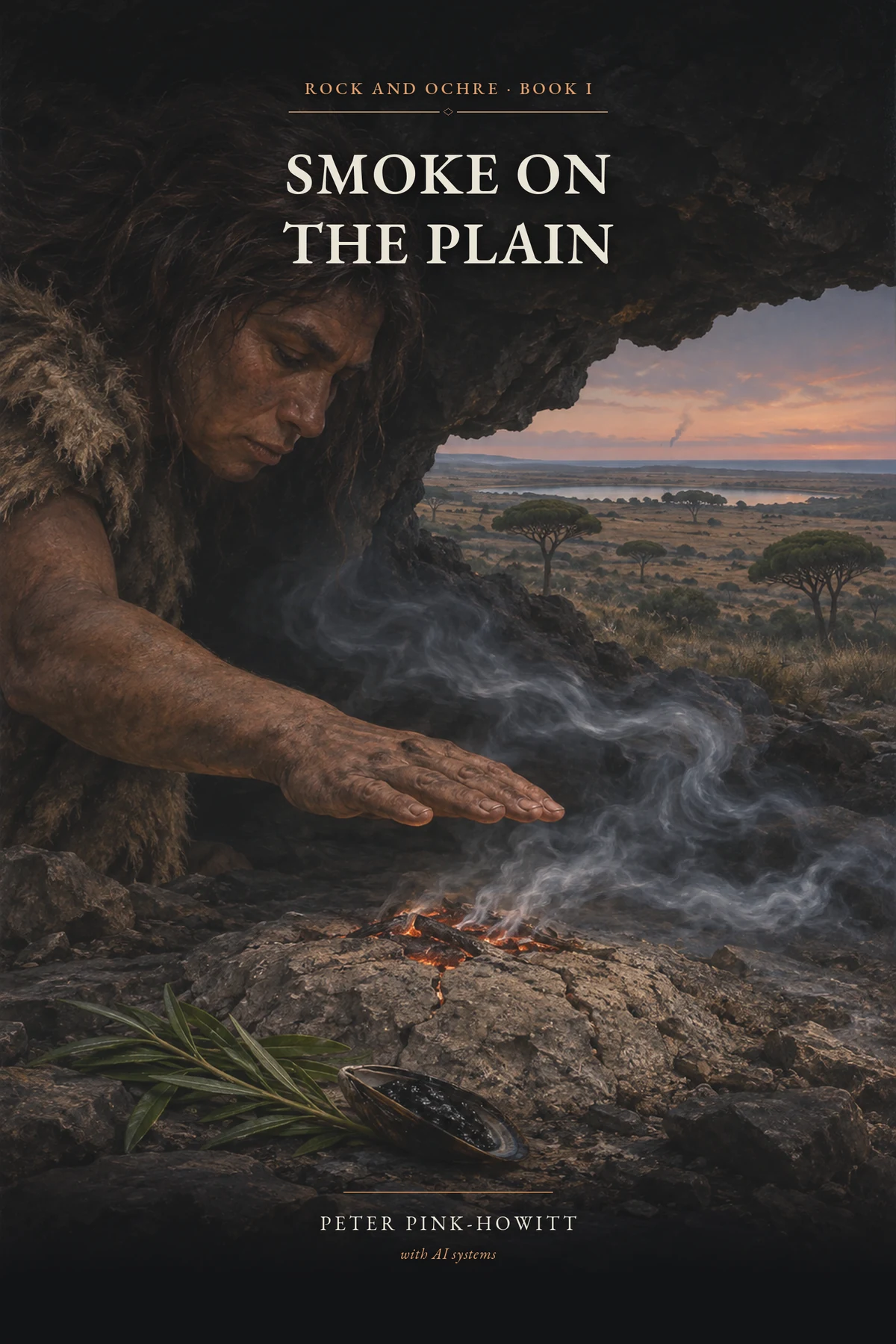
c. 41,200 cal BP · Year 1 — MIS 3 Alboran sea level stands ~80 m below present, exposing a 4.5 km coastal stone-pine savanna, dune lagoons, and Mytilus beds east of Gorham’s and Vanguard Caves (Rodríguez-Vidal et al. 2013). · Book I (Smoke on the Plain): Kesh seals her rockrose tar pit (~100 ml pitch from 1.9 kg young leaves) at Vanguard’s mouth, walks a full-day 17 km trek northwest for Guadarranque honey chert, and Sarn spots coastal camp-smoke on the eastern dunes.
c. 41,100–40,900 cal BP · Years 2–4 — Cut-marked corvid and dark raptor wing bones in Gorham’s, Vanguard, and Ibex Caves attest systematic removal of primary remiges rather than meat consumption (Finlayson et al. 2012). · Book I: Griffon-vulture and dark raptor/corvid primary harvesting on the 280 m crags, followed by a six-sleep 115 km inland drought trek up the Guadiaro–Ronda–Turón corridor.
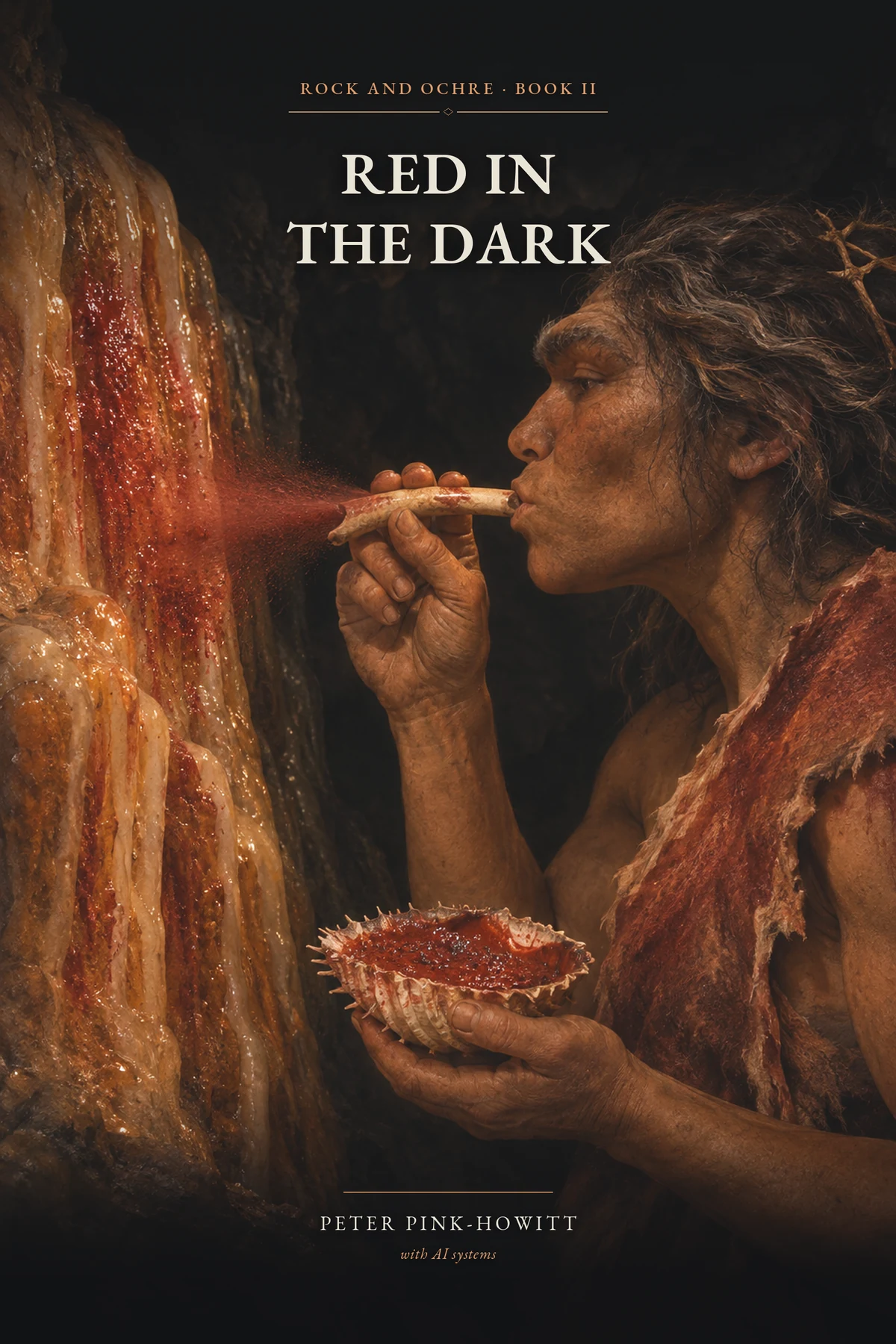
c. 40,400–39,900 cal BP · Years 8–16 — Second U-Th dated pigment horizon at Cueva de Ardales (48.7–45.3 ka into late Mousterian) confirms repeated returns to blow non-local iron oxide across the Sala de las Estrellas curtains. · Book II (Red in the Dark): Kesh and Sarn walk the six-sleep 115 km Guadiaro–Ronda–Turón karst corridor to spit fresh #943424 exogenous haematite across Ardales’s dark-zone curtains.
c. 40,300–40,000 cal BP · Málaga Bay Shell-Strands — Early Upper Palaeolithic / Aurignacian occupation replaces late Mousterian Level Bj/14 in Level Bj/13 at Bajondillo Cave, Málaga Bay (43–41 cal ka BP, Cortés-Sánchez et al. 2019; debated in de la Peña 2019). · Book II: Coastal barter and fragile hearth-truce between Gibraltar’s Mousterian cave-kin and the Early Aurignacian Tritia-shell strands ascending from Málaga Bay as seam-born Neth / Aruelai grows between two worlds.
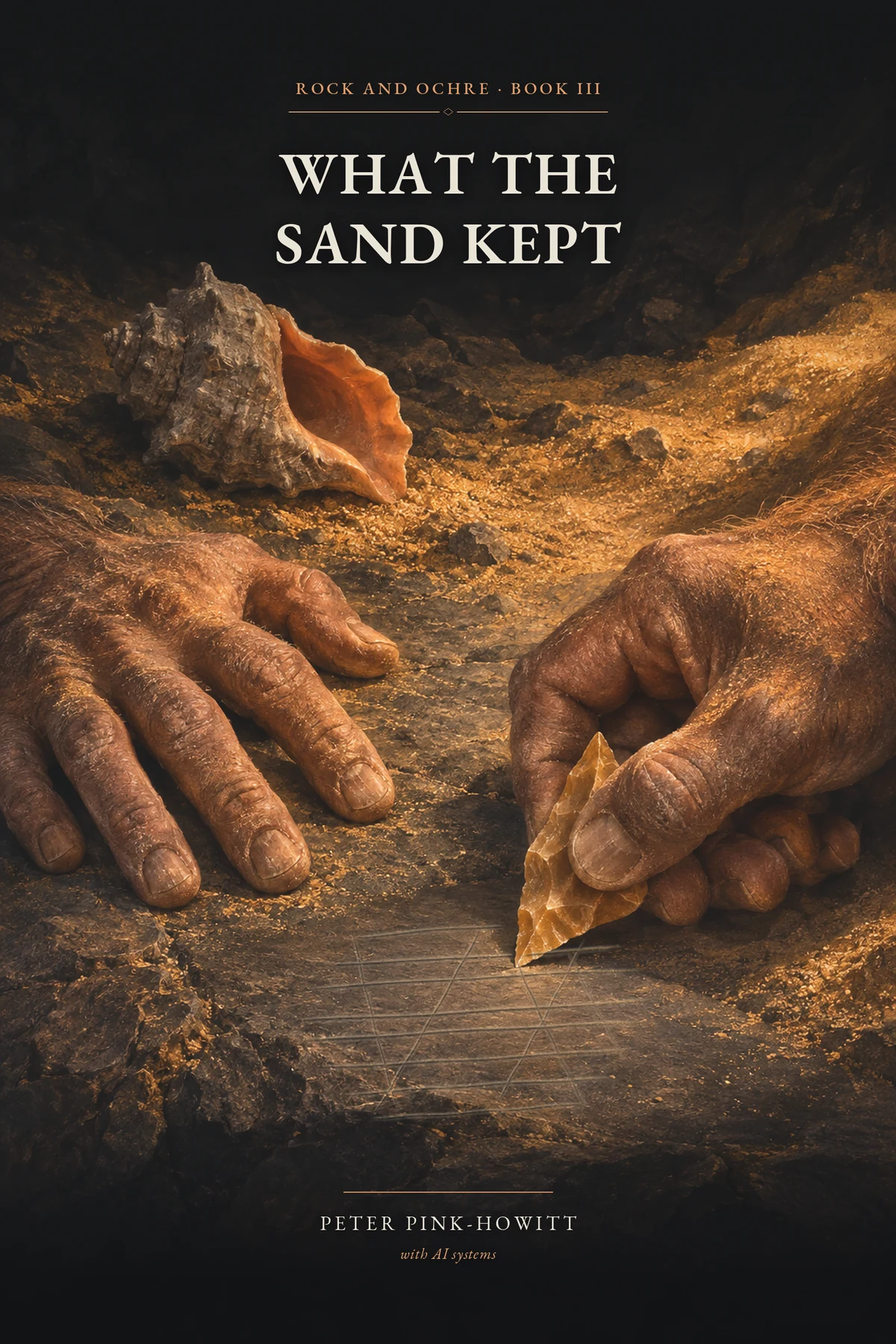
c. 39,600 cal BP · Gorham’s Rear Platform — Thirteen intersecting grooves (8 deep V-profiles + 5 thinner strokes; 188–317 unidirectional flint passes) are incised into a ~300 cm² dolomitic lime-mudstone platform sealed beneath Mousterian Level IV (>39,000 cal BP, Rodríguez-Vidal et al. 2014). · Book III (What the Sand Kept): Thirteen intersecting grooves cut by 188–317 unidirectional honey-chert passes into Gorham’s rear bedrock beside the pine-wood hearth.
c. 39,500 cal BP · Heinrich Stadial 4 — Cold-arid gale winds bank carbonate marine sands across Vanguard Cave’s upper 13 m chamber, sealing lynx, hyaena, griffon vulture, and a carried marine whelk shell untouched until September 2021 (Gibraltar Release 676/2021; Higham et al. 2014). · Book III: Heinrich Stadial 4 carbonate sand closes Vanguard’s upper 13 m arch as the seam-born siblings part between the Rock and the eastern coastal shell-network.